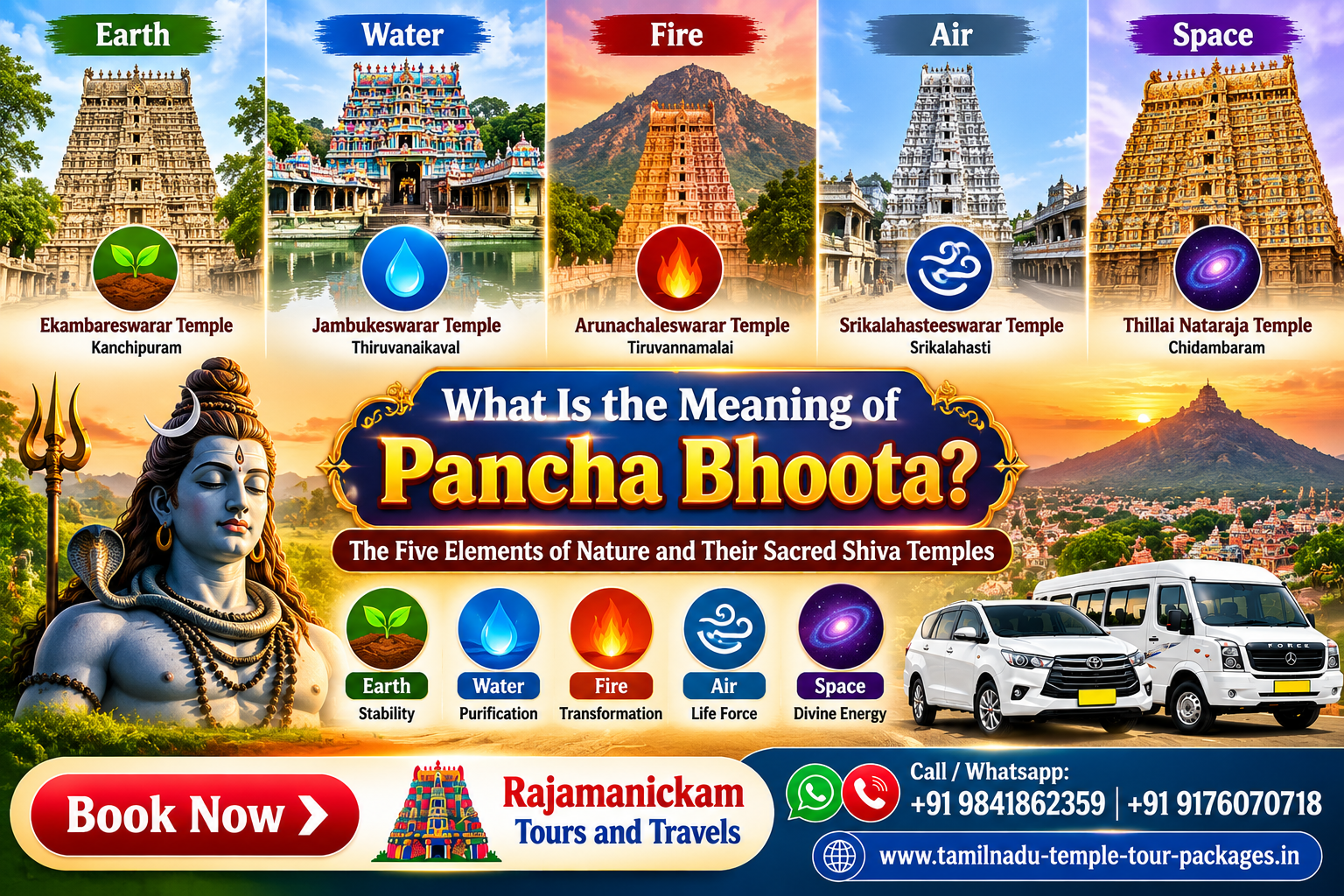
What Is the Meaning of Pancha Bhoota? A Complete Guide to the Five Elements
Have you ever wondered what the term Pancha Bhoota means in Hindu spirituality? Pancha Bhoota refers to the five fundamental elements believed to form the natural world and all living beings. These elements play an important role in Hindu philosophy, traditional Indian thought and the worship of Lord Shiva.
The five elements are Earth, Water, Fire, Air and Space. Each represents a different aspect of nature and is associated with a famous Shiva temple in the tradition of the Pancha Bhoota Sthalams in South India.
In this guide, you will learn the meaning of Pancha Bhoota, the importance of each element and the five sacred temples associated with them.
What Is the Meaning of Pancha Bhoota in English?
The word Pancha Bhoota comes from Sanskrit and can be divided into two parts:
- Pancha means five.
- Bhoota refers to an element or fundamental component of nature.
Therefore, Pancha Bhoota means the five elements of nature.
In traditional Hindu philosophy, these elements are understood as the basic components of the physical universe. They are also used to explain the relationship between the human body, the natural world and the wider universe.
The five Pancha Bhoota elements are:
- Prithvi – Earth
- Jala or Appu – Water
- Agni or Thejas – Fire
- Vayu – Air
- Akasha – Space
Each element has a unique symbolic meaning and is associated with a particular Shiva temple in South India.
What Are the Five Elements of Pancha Bhoota?
1. Prithvi – The Earth Element
The Earth element represents stability, strength, support and the physical structure of life. It symbolises the solid aspects of nature and reminds us of our connection to the land on which we live.
In the Pancha Bhoota Sthalam tradition, the Earth element is associated with Ekambareswarar Temple in Kanchipuram, Tamil Nadu. This important Shiva temple is a major destination for devotees and pilgrims.
The temple is particularly known for its spiritual significance and impressive Dravidian architecture.
Temple: Ekambareswarar Temple, Kanchipuram
Element: Earth
Deity: Lord Shiva
2. Jala – The Water Element
Water represents life, purification, nourishment and adaptability. It is essential for all living beings and is often associated with cleansing and renewal in Hindu religious traditions.
The Water element is represented by Jambukeswarar Temple at Thiruvanaikaval near Tiruchirappalli, Tamil Nadu. The temple is famous for its association with water and its importance in Shaivite worship.
Devotees visit this sacred place to offer prayers to Lord Shiva and experience its traditional temple atmosphere.
Temple: Jambukeswarar Temple, Thiruvanaikaval
Element: Water
Deity: Lord Shiva
3. Agni – The Fire Element
Fire represents energy, transformation, light and spiritual purification. In Hindu traditions, fire has an important place in rituals and ceremonies, symbolising the transformation of offerings and the removal of darkness.
The Fire element is associated with Arunachaleswarar Temple, also known as Annamalaiyar Temple, in Tiruvannamalai, Tamil Nadu.
The sacred Arunachala Hill is closely connected with the temple’s spiritual significance. The temple and hill attract large numbers of devotees, especially during the annual Karthigai Deepam festival.
Temple: Arunachaleswarar Temple, Tiruvannamalai
Element: Fire
Deity: Lord Shiva
4. Vayu – The Air Element
Air represents movement, breath and the life force that sustains living beings. It is associated with circulation, motion and the invisible forces that connect the natural world.
The Air element is represented by Srikalahasteeswara Temple in Srikalahasti, Andhra Pradesh. The temple is a prominent pilgrimage destination dedicated to Lord Shiva.
It is also widely known for its association with Rahu-Ketu worship. Many devotees visit the temple for prayers and traditional religious rituals.
Temple: Srikalahasteeswara Temple, Srikalahasti
Element: Air
Deity: Lord Shiva
5. Akasha – The Space Element
Akasha means Space or Ether. It represents openness, vastness and the space in which all things exist. In traditional Indian philosophy, it is associated with the subtle dimension that allows other elements and forms to exist.
The Space element is associated with Thillai Nataraja Temple in Chidambaram, Tamil Nadu. The temple is famous for Lord Shiva in the form of Nataraja, the cosmic dancer.
Chidambaram holds a special place in Shaivite tradition and is an important destination for devotees interested in the spiritual symbolism of the five elements.
Temple: Thillai Nataraja Temple, Chidambaram
Element: Space
Deity: Lord Shiva as Nataraja
Pancha Bhoota Sthalams: The Five Sacred Shiva Temples
The Pancha Bhoota Sthalams are five sacred temples associated with the five elements. They are located in Tamil Nadu and Andhra Pradesh and are important pilgrimage destinations for devotees of Lord Shiva.
| Element | Temple | Location |
|---|---|---|
| Earth – Prithvi | Ekambareswarar Temple | Kanchipuram, Tamil Nadu |
| Water – Jala | Jambukeswarar Temple | Thiruvanaikaval, Tamil Nadu |
| Fire – Agni | Arunachaleswarar Temple | Tiruvannamalai, Tamil Nadu |
| Air – Vayu | Srikalahasteeswara Temple | Srikalahasti, Andhra Pradesh |
| Space – Akasha | Thillai Nataraja Temple | Chidambaram, Tamil Nadu |
Together, these temples form a significant pilgrimage circuit for devotees who wish to visit all five sacred Shiva shrines.
What Is the Spiritual Significance of Pancha Bhoota?
Pancha Bhoota is more than a list of natural elements. In Hindu philosophical traditions, the five elements help explain the relationship between the human body and the universe.
Each element has a symbolic role:
- Earth: Stability and physical support.
- Water: Nourishment and purification.
- Fire: Energy and transformation.
- Air: Movement and breath.
- Space: Openness and the environment in which everything exists.
The concept encourages people to recognise the importance of nature and the interconnectedness of life. Worship at the Pancha Bhoota Sthalams allows devotees to connect with these ideas through prayer, tradition and temple visits.
Why Do Devotees Visit the Pancha Bhoota Sthalams?
Devotees visit these five temples to worship Lord Shiva, experience their spiritual heritage and explore the significance of the five elements.
Each temple has its own history, architecture, rituals and local traditions. Visiting all five can be a meaningful pilgrimage for families, groups of devotees and travellers interested in South Indian temple culture.
Some visitors complete the pilgrimage over several days, while others plan separate trips to individual temples based on their location and available time.
How to Plan a Pancha Bhoota Sthalam Tour from Chennai
If you are planning to visit the five sacred Shiva temples, it is useful to organise your itinerary in advance. The temples are spread across different locations, so the total duration depends on your starting point, travel route and the amount of time you wish to spend at each temple.
A tour can be planned over multiple days, with stops in Kanchipuram, Tiruvannamalai, Chidambaram, Thiruvanaikaval near Tiruchirappalli and Srikalahasti.
When preparing your itinerary, consider:
- The order of temple visits and driving distances.
- Temple opening hours and darshan schedules.
- Time for meals, rest and overnight stays.
- Your group’s size and preferred transportation.
- Additional sightseeing or pilgrimage destinations.
For families and groups travelling from Chennai, a private car or Tempo Traveller can make it easier to coordinate the journey. Select the vehicle according to your passenger count and travel requirements.
Pancha Bhoota Sthalam Tour Package with Rajamanickam Tours and Travels
Planning a pilgrimage to the five Pancha Bhoota Sthalams? Rajamanickam Tours and Travels offers travel arrangements for temple tours from Chennai, with car rental and Tempo Traveller options for families and groups.
You can enquire about customised itineraries based on your preferred travel dates, trip duration and temple priorities.
Call / WhatsApp: +91 9841862359 | +91 9176070718
Here is a List Of Pancha Bhoota Sthalam Tour package Quick Link
Chennai to Pancha Bhoota Sthalam Package
Trichy to Pancha Bhoota Sthalam Package
Tirupati to Pancha bhoota Temple Tour package
Bangalore to PanchaBhoota Package
Contact us to discuss your Pancha Bhoota Sthalam pilgrimage and suitable transportation options.
Frequently Asked Questions About Pancha Bhoota
1. What does Pancha Bhoota mean?
Pancha Bhoota means the five fundamental elements in traditional Hindu philosophy: Earth, Water, Fire, Air and Space.
2. What are the five Pancha Bhoota elements?
The five elements are Prithvi (Earth), Jala (Water), Agni (Fire), Vayu (Air) and Akasha (Space).
3. What are the Pancha Bhoota Sthalams?
The Pancha Bhoota Sthalams are five sacred Shiva temples associated with the five elements: Ekambareswarar in Kanchipuram, Jambukeswarar in Thiruvanaikaval, Arunachaleswarar in Tiruvannamalai, Srikalahasteeswara in Srikalahasti and Thillai Nataraja in Chidambaram.
4. Which temple represents the Earth element?
Ekambareswarar Temple in Kanchipuram, Tamil Nadu, is associated with the Earth element.
5. Which temple represents the Fire element?
Arunachaleswarar Temple in Tiruvannamalai, Tamil Nadu, represents the Fire element.
6. Which temple represents the Space element?
Thillai Nataraja Temple in Chidambaram, Tamil Nadu, is associated with the Space element.
7. Can I visit all five Pancha Bhoota temples in one trip?
Yes. You can plan a multi-day pilgrimage covering all five temples. The ideal duration depends on your starting point, travel route, darshan time and whether you want to include overnight stays.
Conclusion
Pancha Bhoota refers to the five elements of nature: Earth, Water, Fire, Air and Space. These elements hold an important place in Hindu philosophical traditions and are represented by five famous Shiva temples in South India.
For devotees, exploring the Pancha Bhoota Sthalams offers an opportunity to experience sacred temple traditions, historic architecture and the spiritual significance of Lord Shiva. With a well-planned itinerary, you can organise a comfortable pilgrimage to these five important destinations.