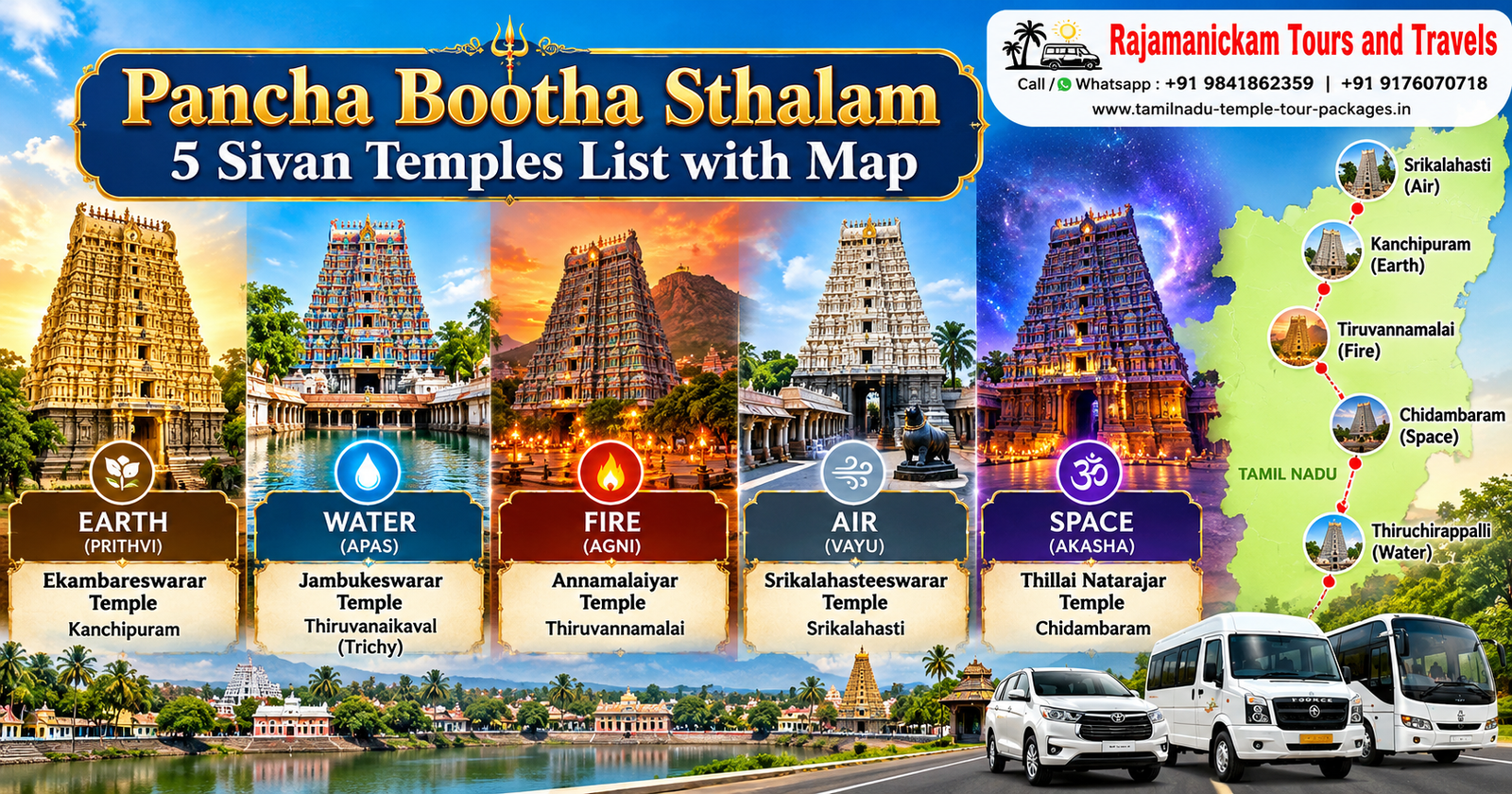
Pancha Bhootha Sthalam 5 Sacred Shiva Temple List With Map & Travel Guide
Pancha Bootha Sthalam refers to the five sacred Sivan temples of South India, each dedicated to one of the five elements of nature: Earth, Water, Fire, Air and Space. In every temple, Lord Shiva is worshipped as a Lingam representing a single element. Four of these temples are in Tamil Nadu, at Kanchipuram, Thiruvanaikaval, Tiruvannamalai and Chidambaram, while Srikalahasti lies in Andhra Pradesh. This guide gives you the complete Pancha Bootha Sthalam temples list with a map, along with legends, highlights and travel tips, so you can plan your pilgrimage with ease.
What Is Pancha Bhoota Sthalam?
Pancha Bhoota Sthalam (also spelled Pancha Bootha Sthalam or Panchabhuta Sthalam) refers to five ancient Shiva temples in South India, each dedicated to one of the five elements (Pancha Bhoota) of nature: Earth, Water, Fire, Air and Space (Ether).
In each temple, Lord Shiva is worshipped as a Lingam representing one element. Four of the temples are in Tamil Nadu and one is in Andhra Pradesh. Together they are among the most visited Shaivite pilgrimage circuits in India.
Pancha Bhoota Sthalam List at a Glance
| # | Element | Temple | Location | Deity (Shiva / Goddess) |
|---|---|---|---|---|
| 1 | Earth (Prithvi) | Ekambareswarar Temple | Kanchipuram, Tamil Nadu | Ekambareswarar / Kamakshi (Elavarkuzhali) |
| 2 | Water (Appu) | Jambukeswarar Temple | Thiruvanaikaval, Tiruchirappalli, Tamil Nadu | Jambukeswarar / Akilandeswari |
| 3 | Fire (Agni) | Arunachaleswarar Temple | Tiruvannamalai, Tamil Nadu | Annamalaiyar / Unnamulai Amman |
| 4 | Air (Vayu) | Srikalahasteeswara Temple | Srikalahasti, Andhra Pradesh | Kalahastheeswara / Gnanaprasunambika |
| 5 | Space (Akasha) | Thillai Nataraja Temple | Chidambaram, Tamil Nadu | Nataraja / Sivakami Amman |
Pancha Bhoota Sthalam Temples Map
Tap any link below to open the exact location in Google Maps:
- Ekambareswarar Temple, Kanchipuram
- Jambukeswarar Temple, Thiruvanaikaval
- Arunachaleswarar Temple, Tiruvannamalai
- Srikalahasteeswara Temple, Srikalahasti
- Thillai Nataraja Temple, Chidambaram
Rough geography: Srikalahasti lies in the north, on the Tamil Nadu–Andhra border. Kanchipuram, Tiruvannamalai and Chidambaram run down the northern and central Tamil Nadu belt. Thiruvanaikaval (Trichy) sits furthest south in the Cauvery delta region.
1. Ekambareswarar Temple, Kanchipuram: Prithvi Lingam (Earth)
Significance
Known as the Prithvi Sthalam, this is the temple of the Earth element. The Lingam here is said to be made of sand, which is why it is not anointed with water during abhishekam (oil and other offerings are used instead).
Legend
Goddess Parvati is believed to have made a Shiva Lingam from sand under a mango tree and worshipped it with great devotion. When the river Vegavathi flooded, she embraced the Lingam to protect it, and the marks of her embrace are said to remain.
Highlights
- A sacred mango tree said to be thousands of years old, with four branches representing the four Vedas
- A massive gopuram and a hall of 1,000 pillars
- Located in Kanchipuram, famous as one of the seven Moksha Puris and for its silk sarees
2. Jambukeswarar Temple, Thiruvanaikaval: Appu Lingam (Water)
Significance
The Appu Sthalam represents the Water element. A natural spring flows beneath the sanctum, and water is always seen around the Lingam, even in summer.
Legend
A spider and an elephant both worshipped Shiva under a Jambu (naval) tree here. The elephant would wash the Lingam with water, and the spider would weave a web above it as a canopy. Their devotion led to the temple’s name, Thiru-aanai-kaval (the sacred elephant grove).
Highlights
- Goddess Akilandeswari faces Shiva in a unique tradition where, in the midday ritual, the priest dresses as a woman to worship Shiva as the goddess
- Sacred Jambu tree within the temple
- Close to Srirangam, so the two can be visited together
3. Arunachaleswarar Temple, Tiruvannamalai: Agni Lingam (Fire)
Significance
The Agni Sthalam represents Fire. The entire Arunachala hill is revered as Shiva in the form of a column of fire.
Legend
Brahma and Vishnu once argued over who was supreme. Shiva appeared as an infinite pillar of fire, and neither could find its beginning or end. The hill is said to be that fiery form made visible.
Highlights
- Karthigai Deepam festival, when a huge beacon is lit on the hilltop (November–December)
- Girivalam, the 14 km circumambulation of the hill, especially on full-moon nights
- One of the largest temple complexes in India, with towering gopurams
- Associated with the sage Sri Ramana Maharshi, whose ashram is nearby
4. Srikalahasteeswara Temple, Srikalahasti: Vayu Lingam (Air)
Significance
The Vayu Sthalam represents Air. A lamp inside the sanctum is said to flicker constantly, even though no windows or openings are visible, symbolizing the presence of wind.
Legend
The name comes from Sri (spider), Kala (serpent) and Hasti (elephant), three devotees who attained liberation here. The hunter-saint Kannappa Nayanar is also celebrated here for his extraordinary devotion.
Highlights
- Famous for Rahu-Ketu Sarpa Dosha puja, which draws pilgrims from across India
- Set at the foot of a hill beside the Swarnamukhi river
- The only Pancha Bhoota temple outside Tamil Nadu
5. Thillai Nataraja Temple, Chidambaram: Akasha Lingam (Space)
Significance
The Akasha Sthalam represents Ether or Space. Instead of a solid Lingam, the main shrine holds the Chidambara Rahasyam, the “secret of Chidambaram”: a space behind a curtain, adorned with a garland of golden vilva leaves, symbolizing the formless, all-pervading divine.
Legend
Shiva is believed to have performed the cosmic Ananda Tandava (Dance of Bliss) here for the sages Patanjali and Vyaghrapada. Chidambaram is also the birthplace of the Nataraja form.
Highlights
- Shiva worshipped as Nataraja in the golden-roofed Kanaka Sabha
- Shrines for both Shiva and Vishnu (Govindaraja Perumal) within one complex
- Four tall gopurams, with the sculptures of the 108 Bharatanatyam karanas
- A major centre for dance, music and Shaivite scholarship
Pancha Bhoota Sthalam Yatra: Best Packages List
A comfortable circuit starting from Chennai covers all five temples in about 3, 4 & 5 days:
- 2 Nights / 3 Days Pancha Bhoota Package Chennai
- 3 Nights / 4 Days Pancha Bhoota Temple Tour from Chennai
- 4 Nights / 5 Days Pancha Bhoota Sthalam Tour Package Chennai
- Trichy to Pancha Bhoota Sthatam Package
- Tirupati to Pancha Bhoota Temple Tour Package
- Bangalore to Pancha Bhoota Sthalam Tour Package
Travel times are approximate and vary with traffic and roads.
Best Time to Visit
- October to March: cooler, comfortable weather for travel
- November–December: Karthigai Deepam in Tiruvannamalai
- Maha Shivaratri (Feb–Mar): special celebrations at all five temples
- Avoid peak summer (April–June): it gets very hot, especially in the interior
Travel & Visiting Tips
- Dress code: traditional, modest attire is expected in all temples; some enforce it strictly
- Timings: most temples open early morning, close in the afternoon, and reopen in the evening. Always confirm current timings locally before you go
- Footwear and phones: footwear is not permitted inside; photography is restricted in sanctums
- Crowds: weekdays and early mornings are quieter
- Stay: book accommodation in advance around festivals and full-moon days
Frequently Asked Questions (FAQ)
What are the Pancha Bhoota Sthalams?
They are five Shiva temples representing Earth, Water, Fire, Air and Space, located in Kanchipuram, Thiruvanaikaval, Tiruvannamalai, Srikalahasti and Chidambaram.
Which Pancha Bhoota temple is not in Tamil Nadu?
Srikalahasteeswara Temple (Air) is in Andhra Pradesh. The other four are in Tamil Nadu.
Do I have to visit the temples in a particular order?
There is no strict rule, but many pilgrims follow the order Kanchipuram, Thiruvanaikaval, Tiruvannamalai, Srikalahasti, Chidambaram, which matches the traditional listing of the elements.
How many days are needed to cover all five?
Around 4–5 days with comfortable travel and rest. A rushed trip can be done in 3 days.
Which temple represents Fire?
Arunachaleswarar Temple, Tiruvannamalai.
Conclusion
The Pancha Bhoota Sthalam circuit blends spirituality, ancient architecture and a deep connection with nature. Whether you are a devotee, a history lover or a traveller seeking meaning, visiting these five temples offers a journey through the elements that shape all life.
Plan your Pancha Bhoota yatra today and experience the five forms of Shiva across South India.