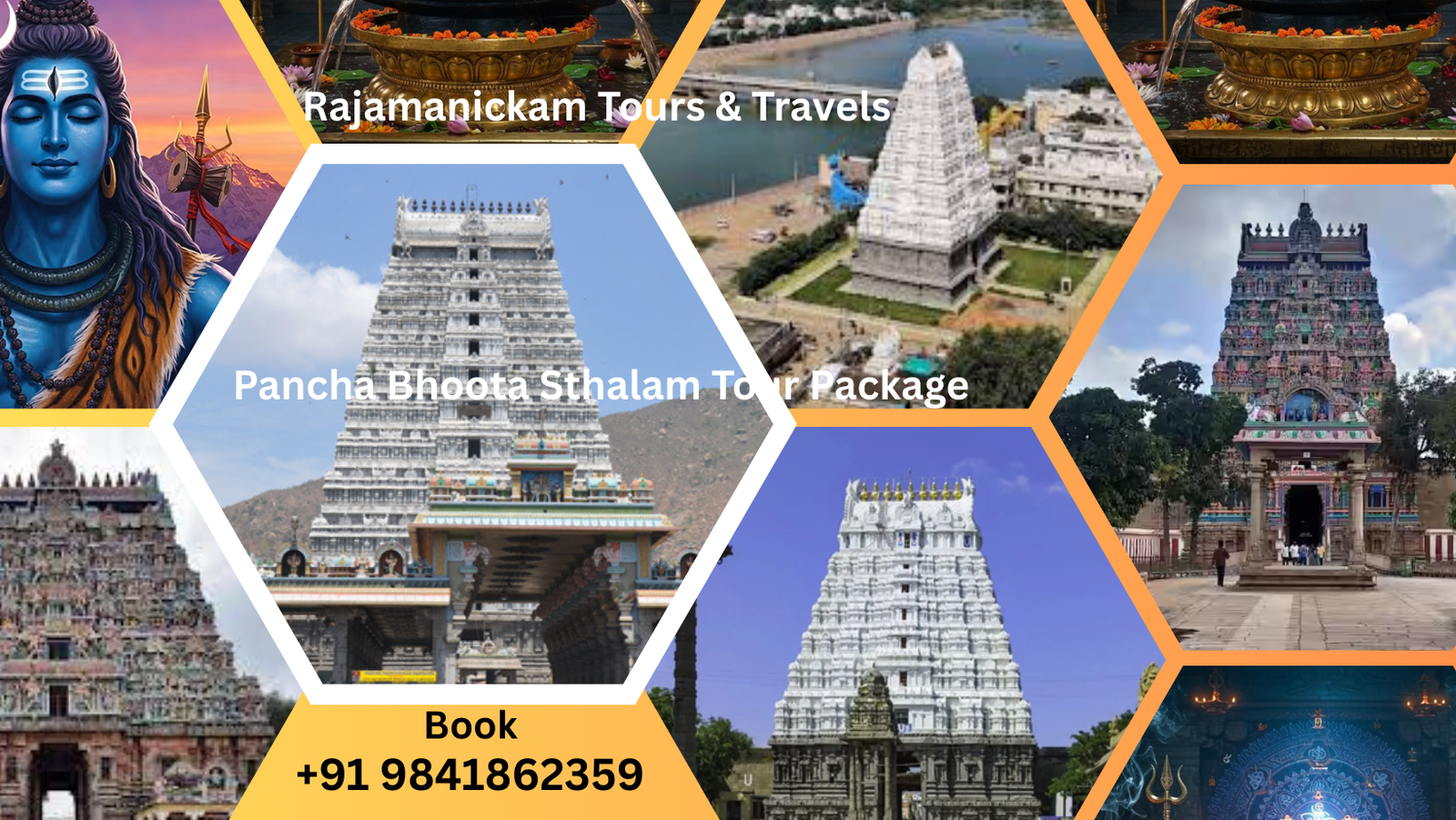
Where Earth, Fire, Water, Air, and Sky Meet Shiva: The Unforgettable Journey Through the Pancha Bhoota Sthalams
Have you ever stood somewhere and felt the raw, pulsating energy of creation itself? A place where mythology, geology, and devotion aren’t just intertwined—they are indistinguishable? That is the promise of the Pancha Bhoota Sthalams, the five elemental abodes of Shiva in South India. This isn’t just a pilgrimage; it’s a sensory and spiritual odyssey that looks, feels, and is outstanding in every sense of the word.
The concept is breathtaking in its simplicity and profundity: Shiva, the supreme destructor and regenerator, manifests in five prime elements (Pancha Bhoota) that constitute the universe. In five sacred temples, he is worshipped not just as a deity, but as the element itself. You don’t just see a representation; you are meant to experience the element in its purest, most sanctified form.
1. Prithvi (Earth) – Ekambareswarar Temple, Kanchipuram, Tamil Nadu
- The Experience: You touch it before you see it. The massive, ancient sthala vriksham (sacred tree)—a 3,500-year-old mango tree—is a living monument. But the true earth-shaking moment is in the inner sanctum. Here, Shiva is not a polished stone but a mound of sand (prithvi lingam). It’s humble, primal, and shockingly real. You are literally touching the planet’s crust in its most consecrated form. The 57-acre temple complex, with its golden gopuram (gateway tower) and thousand-pillared hall, feels like a city built on the bedrock of existence itself.
2. Jala (Water) – Jambukeswarar Temple, Thiruvanaikaval, Trichy
- The Experience: You descend. Deep into the dark, water-submerged sanctum. Here, Shiva as Appu Lingam (water lingam) is constantly immersed in a spring-fed underground water tank. The air is cool, damp, and the sound of dripping water is a constant mantra. Priests wade through the water to perform abhishekam (ritual bathing). It’s a visceral lesson in fluidity, adaptability, and the source of all life. You don’t just worship water; you worship in water, acknowledging that creation flows from it.
3. Agni (Fire) – Arunachaleswarar Temple, Tiruvannamalai, Tamil Nadu
- The Experience: You feel it from miles away—a magnetic pull. The massive Annamalai Hill is the fire lingam. A column of radiant, radiating energy. On full moon nights (purnima), the Karthigai Deepam festival sees a colossal fire lit atop the hill, visible for 30 kilometers. It’s a spectacle of cosmic fire, a physical manifestation of Shiva’s fiery aspect of transformation. Circumambulating (girivalam) the hill is to walk around a living, breathing furnace of spiritual energy. The temple itself, one of the largest in India, feels like it’s guarding this eternal flame.
4. Vayu (Air) – Kalahasteeswara Temple, Srikalahasti, Andhra Pradesh
- The Experience: You hear it in the constant, whispering wind through the cavernous temple. Dedicated to Vayu, the wind god, the temple is famous for its self-manifested (svayambhu) lingam that seems to tremble with air. The highlight is the breathtaking roofed circumambulatory path around the sanctum—a rare feature—where you walk with the wind swirling around you. It’s the temple of breath, of the invisible force that animates all life. The nearby Srikalahasti town seems perpetually in motion, just like the element it venerates.
5. Akasha (Sky/Space) – Chidambaram Nataraja Temple, Tamil Nadu
- The Experience: You enter it… and you don’t. This is the most esoteric and profound. The Nataraja (Shiva as the Cosmic Dancer) is housed in the Kanaka Sabha (Golden Hall). But the true Akasha lingam is the space behind the silk curtain* in the innermost sanctum. Priests reveal it only during rare rituals: it is nothingness. Empty space. The formless void from which all form emerges. It’s a mind-bending concept—worshipping the sky, the unmanifest, the boundless. The temple’s gold-plated roof mimics the heavens, and the entire structure is built on the spot where Shiva’s dance of creation and dissolution is said to be perpetually witnessed by the gods.
Why This Journey Looks & Feels “Outstanding”
It’s outstanding because it’s multi-dimensional:
- Geologically: You engage with a living hill, an underground spring, a sacred tree, and an empty void.
- Architecturally: Each temple is a UNESCO-worthy marvel of Dravidian architecture, from Kanchipuram’s towering gopurams to Chidambaram’s symbolic halls.
- Sensory: You feel cool water drip on your head, hear the wind in stone corridors, see a hill blaze with fire, touch ancient earth, and confront the concept of pure space.
- Philosophically: It turns abstract elements into tangible teachers. Water teaches fluidity. Fire teaches purification. Sky teaches boundlessness. Earth teaches stability. Air teaches movement.
Popular Pancha Bhoota Sthalams Tours List
| Tour Name | Duration | Price View |
|---|---|---|
| Chennai to 5 Elements Tour | 3 Days | View Price |
| Chennai to Pancha Bhoota Temples Package | 4 Days | View Price |
| Chennai to Pancha Bhoota Lingam Tour Package | 5 Days | View Price |
| Trichy to Pancha Bhoota Temples Tour | 4 Days | View Price |
| Tirupati To Pancha Bhoota Temples Tour | 4 Days | View Price |
| Rameshwaram to Pancha Bhoota Sthalam Tour package | 4 Days | View Price |
| Bengalore to Pancha Bhoota Temples Tour Package | 4 Days | View Price |
Practical Pilgrimage Tips
- Best Time: October to March, avoiding the extreme heat and monsoon.
- Route: They form a rough triangle in Tamil Nadu (+ one in Andhra Pradesh). A logical loop: Kanchipuram (Earth) → Tiruvannamalai (Fire) → Chidambaram (Sky) → Tiruchirappalli (for Thiruvanaikaval/Water) → Srikalahasti (Air).
- Dress Code: Modest clothing (dhoti/mundu for men, saree/salwar for women) is mandatory. Bare feet are the norm.
- Mindset: Go with patience. These are living, bustling temples with long queues. The reward is in the slow, deliberate immersion.
- Guides: Consider hiring a knowledgeable local guide to unlock the deep symbolism and mythology.
The Takeaway: You Are the Element
The ultimate realization on this path is this: the Pancha Bhootas aren’t just out there in the temples. They are in you. Your body is earth. Your blood and breath are water and air. Your metabolism is fire. Your consciousness is space. The pilgrimage is a mirror, reflecting the cosmos within.
Exploring the Pancha Bhoota Sthalams is not about checking off a list. It’s about letting five fundamental forces of nature reorient your entire being. It’s a journey that looks, on the surface, like visiting five impressive temples.
But when you stand at the foot of Arunachala as it glows, wade in the water of Thiruvanaikaval, touch the sand lingam of Kanchipuram, feel the wind in Srikalahasti, and gaze upon the empty space of Chidambaram…
You understand. You have not just seen outstanding. You have touched, felt, heard, and become the outstanding essence of existence itself.
Pack your curiosity, your reverence, and your walking shoes. The elements await.